
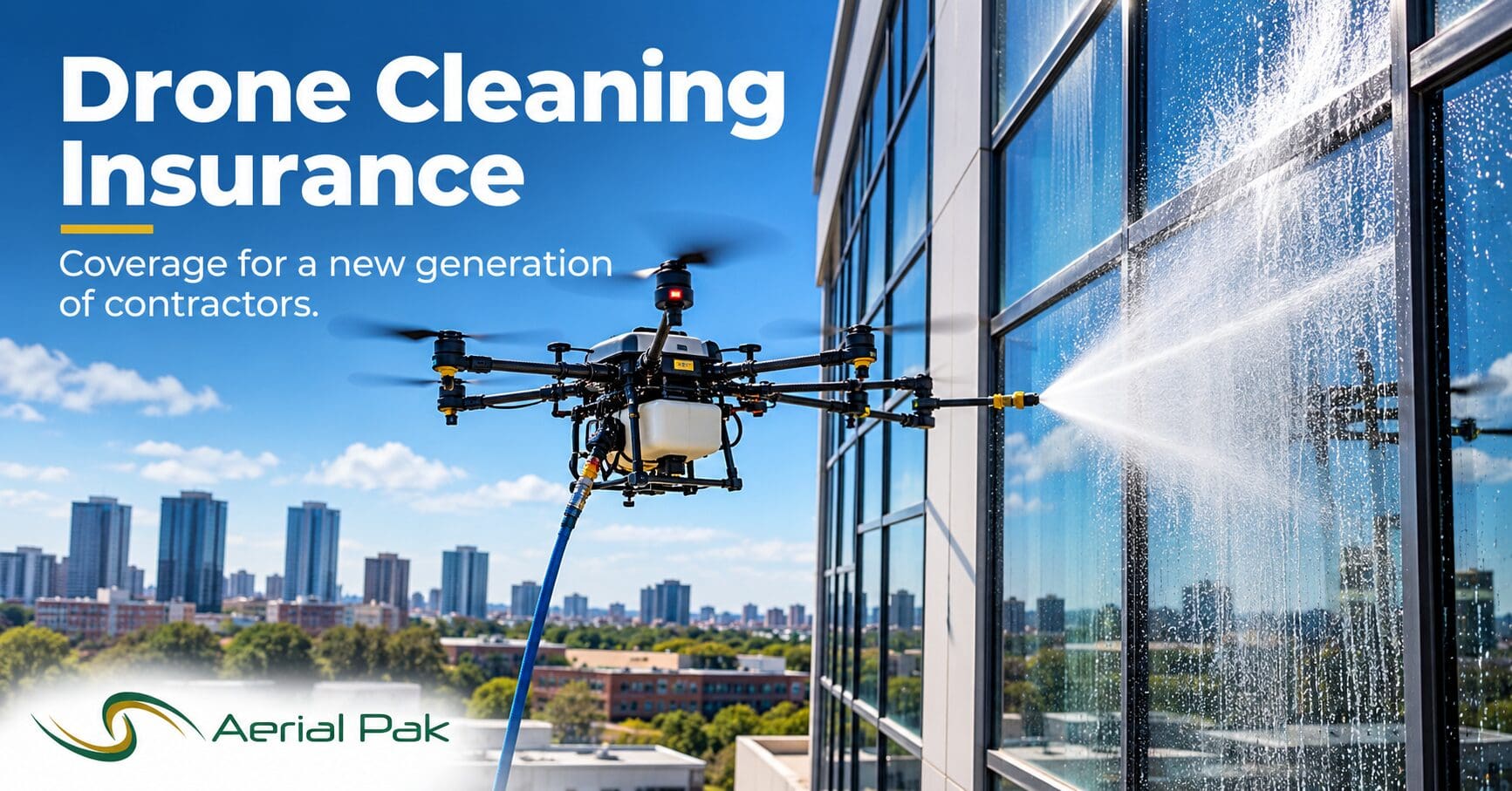
Drone technology is changing how contractors clean windows, facades, roofs, solar panels, and other hard-to-reach exterior surfaces.
Instead of putting workers on lifts, scaffolding, or suspended platforms, drone cleaning companies can use specialized aircraft connected to ground-based pressure washing or soft washing systems.
But insuring these businesses is not as simple as buying a drone policy or a pressure washing policy.
Drone cleaning combines aviation and exterior cleaning exposures, and your insurance program needs to account for both.
At Hill & Usher, we work with commercial drone operators to build insurance programs around the way their businesses actually operate.
Apply for Drone Cleaning Insurance
Why Drone Cleaning Businesses Need Specialized Insurance
A typical drone cleaning operation may involve much more than the aircraft itself.
Depending on the business, an operation could include:
- Commercial cleaning drones
- Ground-fed hoses or tether systems
- High-pressure pumps
- Water tanks
- Soft washing and cleaning chemicals
- Generators and filtration systems
- Wash-kit trailers
- Tow vehicles
- Employees and ground crews
- Subcontractors
A single cleaning drone may cost $40,000 or more, while a fully equipped wash trailer can add significant additional property value.
Meanwhile, the work may take place around pedestrians, vehicles, expensive building facades, windows, solar panels, rooftop equipment, and other property.
That combination creates exposures that may fall under several different types of insurance.
Drone Liability Is Only Part of the Picture
Commercial drone liability insurance is an important starting point.
A drone liability policy is generally designed around liability arising from operation of the insured aircraft. For a drone cleaning contractor, that can be important if a drone causes bodily injury or damages someone else’s property.
But operating the aircraft is only one part of the business.
Consider a Few Examples
A drone collides with a building and breaks a window.
That loss has a direct connection to operation of the aircraft.
A hose lying across the worksite causes someone to trip.
That’s a traditional contracting or premises exposure.
Cleaning solution damages landscaping or neighboring property.
The claim may involve the cleaning operation and potentially pollution-related coverage considerations.
Water enters a building through a window or facade joint.
The facts of the loss and the wording of the applicable policies become particularly important.
That’s why we generally look at drone liability and General Liability as separate but coordinated coverages, rather than assuming either policy covers the entire operation.
General Liability for the Cleaning Operation
Drone cleaning companies are still cleaning contractors.
General Liability can be an important part of the insurance program for exposures involving the contractor’s premises and operations, including exposures that exist independently of operation of the aircraft.
However, not every General Liability policy is appropriate for this type of business.
Important considerations can include:
- Exterior building cleaning eligibility
- Pressure or soft washing
- Maximum building height
- Roof work
- Work on apartments or residential properties
- Subcontracted operations
- States where work is performed
- Chemicals and cleaning solutions
- Damage to the property being cleaned
- Products-completed operations
- Aircraft exclusions
The details matter.
A policy written for an ordinary cleaning business should not automatically be assumed to cover a business using drones to perform the work.
Protecting a $40,000+ Cleaning Drone
Liability is not the only concern.
Specialized cleaning drones can represent a significant investment. A single aircraft may start around $40,000, with some configurations costing substantially more.
Drone Hull coverage can help address physical damage to a scheduled aircraft, subject to the terms and conditions of the policy.
Businesses should also consider the equipment surrounding the aircraft, such as:
- Cleaning payloads and attachments
- Controllers and ground stations
- Batteries and chargers
- Spare equipment
- Cameras and sensors
It is important to understand what is included in the insured value of the aircraft and what equipment may need to be insured separately.
Don’t Forget the Wash Trailer
For many drone cleaning companies, one of the biggest concentrations of property is not inside a building. It is traveling down the road.
A wash-kit trailer may contain:
- Large water tanks
- High-pressure pumps
- Hose reels
- Filtration or deionization systems
- Generators
- Cleaning chemicals
- Tools
- Batteries and electrical equipment
- Other specialized cleaning equipment
The trailer itself and the equipment mounted to or carried on it may not necessarily be insured the same way.
Commercial Auto, trailer physical damage, and Inland Marine or Equipment Floater coverage may all need to be considered depending on the equipment and how it is transported.
Your towing exposure matters too. Water weighs approximately 8.34 pounds per gallon, so a large tank can dramatically change the loaded weight, handling, and braking characteristics of a trailer.
Inland Marine and Equipment Coverage
A drone cleaning company can have a surprising amount of mobile property.
In addition to the drone, the business may routinely transport tens of thousands of dollars of pumps, generators, hoses, filtration equipment, tools, controllers, batteries, and other equipment between jobsites.
An Inland Marine or Equipment Floater policy may be appropriate for certain mobile equipment.
We also look at where equipment is stored and whether drones and other high-value property are ever left overnight in vehicles or trailers.
One theft could potentially involve the trailer, wash equipment, tools, and one or more expensive drones at the same time.
What Other Insurance Might a Drone Cleaning Business Need?
Depending on the operation, an insurance program could include:
| Coverage | What It May Address |
|---|---|
| Drone / UAS Liability | Liability arising from operation of scheduled drones |
| Drone Hull | Physical damage to scheduled aircraft |
| General Liability | Non-aviation contracting and cleaning exposures |
| Inland Marine / Equipment Floater | Mobile wash equipment, tools, and other property |
| Commercial Auto | Business-owned vehicles and towing exposures |
| Hired & Non-Owned Auto | Certain business use of rented, borrowed, or personal vehicles |
| Workers Compensation | Employee injuries arising from work |
| Contractors Pollution Liability | Certain chemical, runoff, wastewater, or environmental exposures |
| Umbrella / Excess Liability | Additional liability limits, subject to the policies scheduled underneath it |
| Property / Business Income | Business property and interruption exposures |
Not every drone cleaning company needs every coverage. The appropriate program depends on the actual operation.
Apply for Drone Cleaning Insurance
What We’ll Want to Know About Your Operation
Drone cleaning is still an emerging class of business, so providing good underwriting information can be especially important.
We’ll typically want to understand things such as:
- What you’re cleaning
- Maximum building height
- States where you operate
- Drone make, model, and value
- Pilot experience and certifications
- How water or cleaning solution reaches the drone
- Maximum pressure and flow rate
- Chemicals or detergents used
- Safety and worksite controls
- Whether employees ever perform manual work at elevation
- Whether you use subcontractors
- Vehicles and trailers
- Water tank capacity
- Value of your wash equipment
- Prior claims or incidents
We’ve designed our application specifically to collect information relevant to drone cleaning operations rather than trying to fit the business into a traditional pressure washing application.
Insurance Built Around How You Actually Clean
Drone exterior cleaning is developing faster than many traditional insurance products.
That does not mean the business is uninsurable. It means the insurance needs to be approached differently.
At Hill & Usher, we can help evaluate the aviation, cleaning, equipment, auto, and other exposures together, identify where separate policies may be necessary, and build an insurance program around your actual operation.
Whether you’re cleaning commercial windows, building facades, roofs, solar panels, parking structures, or other exterior surfaces, we’d like to learn more about your business.
Get a Drone Cleaning Insurance Proposal
Tell us about your drones, cleaning system, equipment, and operations. Our application is designed specifically to gather the information we need to evaluate insurance options for a drone cleaning business.
Coverage is subject to underwriting, eligibility, policy terms, conditions, limitations, and exclusions. Coverage availability varies by risk, carrier, and state.